
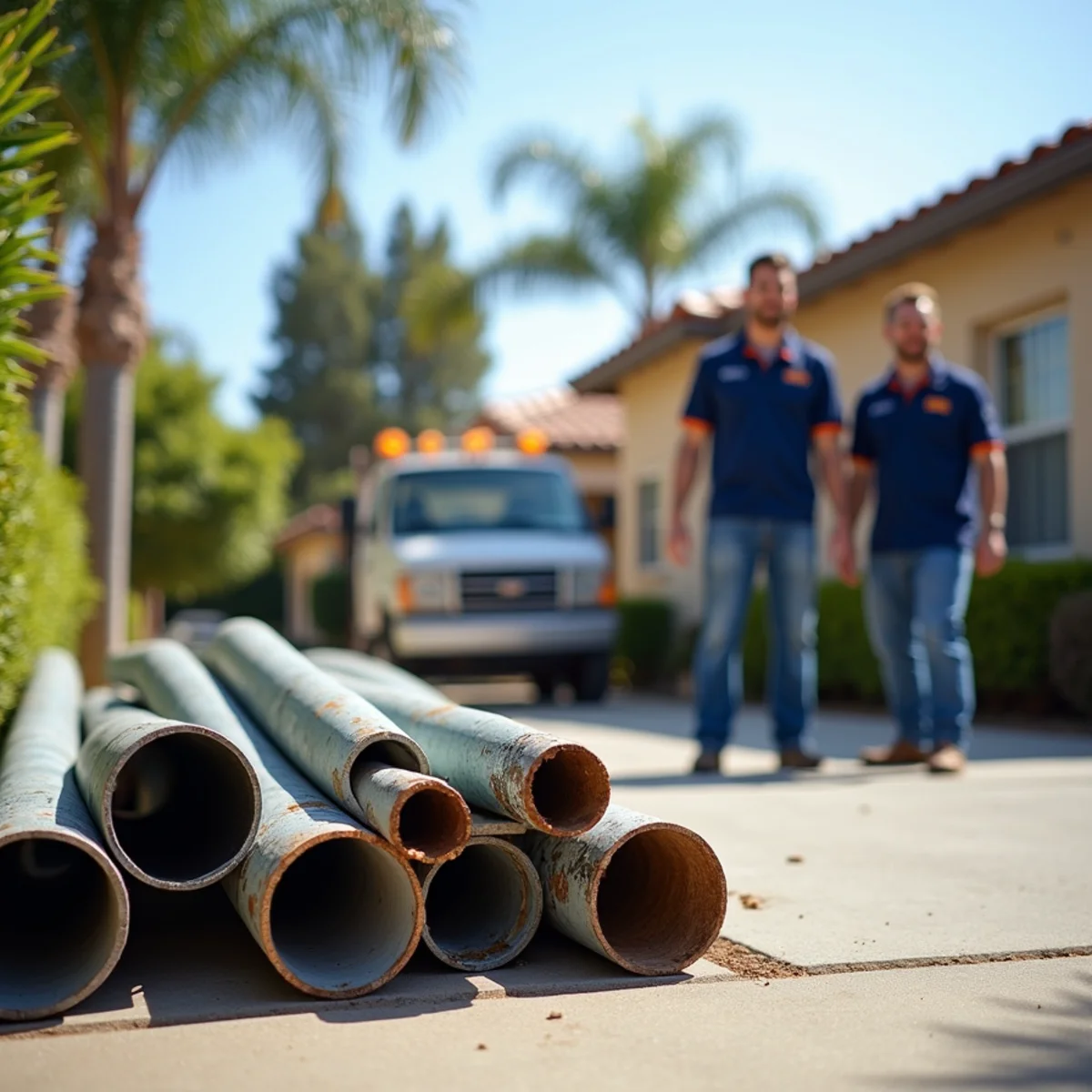
What galvanized is and why it fails
Galvanized steel pipe was the standard for residential water supply in the U.S. from about 1920 through the late 1960s. Steel pipe was dipped in molten zinc to coat the inside and outside — the zinc is a sacrificial layer that corrodes preferentially so the steel does not.
Two problems: (1) the zinc coating exhausts after decades of use, and (2) chlorinated municipal water accelerates the depletion. Once the zinc is gone, the steel starts to rust. Rust on the interior wall builds up as bulbous flakes that reduce the pipe's inside diameter — a 3/4-inch pipe can end up flowing like 3/8-inch — and eventually breaches the wall entirely.
In Spring Valley, National City, and other pre-1970 South Bay neighborhoods, we still find homes on original galvanized every week.
How to tell if you have galvanized
Visual inspection: if you have exposed pipe under the sink, in the crawl space, or in the garage — is it a dull gray metal with visible threading at fittings? That is galvanized. Copper is red-orange or oxidized green. PEX is red, blue, or white flexible plastic. PVC is white or beige plastic.
Water symptoms: rust-colored water first thing in the morning (rust settled in the pipe overnight). Very low pressure at faucets even after cleaning aerators. Discolored spots on porcelain after the water sits.
Age of home: built between 1920 and 1970 and never repiped? Assume galvanized until you confirm otherwise.
Home inspection report: an inspection at purchase should have flagged pipe material.
The failure timeline
Original galvanized in the South Bay reaches these milestones:
- Year 30–40: interior scale reduces flow; first pressure complaints
- Year 40–50: first pinhole leaks at fittings and low points
- Year 50–60: cascading failures — multiple pinholes per year
- Year 60+: full ruptures become common; system is on borrowed time
Most pre-1970 South Bay homes are now in the year 55–75 window. This is why we do so many repipes.
PEX vs. copper — the actual tradeoffs
PEX (cross-linked polyethylene) — our default:
- Flexible; fewer joints (fewer failure points)
- Immune to scale buildup
- Does not pit or corrode from chlorinated water
- 20–30% cheaper installed than copper
- 25-year manufacturer warranty
- Code-approved throughout San Diego County
- Colored red (hot) and blue (cold) for easy identification
Copper — still right in specific cases:
- Exposed decorative runs
- High-temperature locations (near boilers)
- Where rodents are a concern in crawl spaces (rare)
- Where buyer preference favors it (some do)
- Longer track record — 60+ years of proven durability
- 20–50 year expected service life
Both are code-compliant. PEX is our default recommendation for 90% of South Bay repipes because it handles hard water and chlorine better and costs less.
The partial repipe question
Homeowners sometimes ask if we can just replace the branch that failed. Sometimes yes, sometimes no.
Partial repipe is reasonable when:
- Only one branch has failed
- The rest of the system has been recently pressure-tested and looks healthy
- Budget is tight and full repipe is not possible this year
- You are selling in the next 12 months
Full repipe is the right answer when:
- Two or more failures in the last 24 months
- Home is 55+ years old and never repiped
- Multiple sections show interior corrosion when opened
- You plan to be in the home 5+ more years
- Insurance is asking questions about repeat claims
We tell you honestly which situation you are in.
What a proper repipe looks like
- New PEX or copper from the meter to every fixture
- New shutoff at every fixture (quarter-turn ball valves)
- New washing machine and refrigerator hookups
- New water heater flex connectors and dielectric unions
- Pressure test to 150 PSI
- City permit and inspector sign-off
- Wall openings patched drywall-ready (level 4)
- 10-year labor warranty
Timeline and disruption
A typical single-story National City repipe: 2 days of work, plus 1 day of patching if included.
- Day 1: material staging, new lines run overhead through attic and interior wall cavities
- Day 2: each fixture switched over to new supply, pressure test, inspector sign-off
- Day 3 (patching): drywall patches, tape, mud, ready for paint
Water is off during work hours only. You sleep in your home each night.
Costs
Real 2025 South Bay ranges are in our repiping cost guide. Short version: single-story bungalow $6,800–$9,500 in PEX; two-story family home $10,500–$14,500 in PEX. Copper is 20–30% more.
Financing
Repipes are financeable with approved credit. 0% intro plans available.
The next step
If your home is on original galvanized, the two questions are (1) how soon, and (2) PEX or copper. The answer to "how soon" depends on how many failures you have already had. The answer to "PEX or copper" is usually PEX.
We give free written estimates on-site. No pressure. Numbers on paper, decision on your timeline. Full whole-house repiping details here.